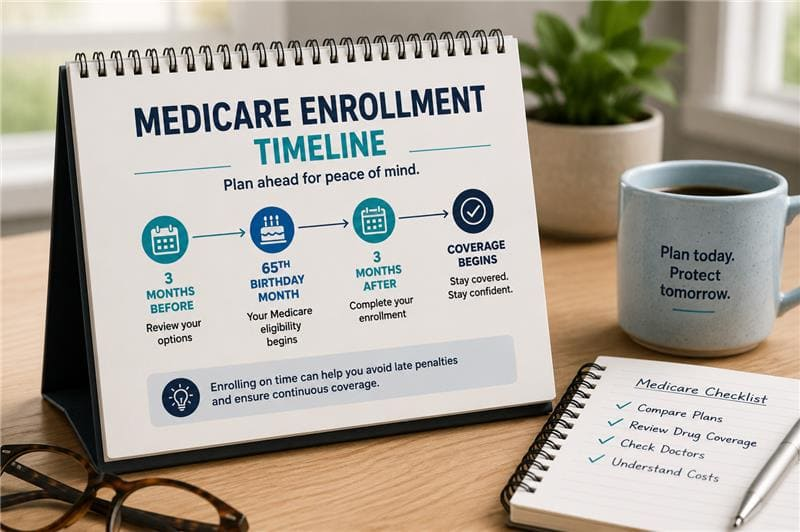
Why Medicare Planning Starts Long Before You Turn 65
Most people begin thinking about Medicare sometime around their 64th birthday. The problem with that timeline is that it does not leave much room for the research, the comparison, and the careful decision-making that Medicare actually requires. By the time you understand all your options clearly enough to choose between them, your enrollment window may already be weeks away.
The clients who come out of the Medicare enrollment process with the fewest regrets are almost always the ones who started the conversation six months or more before they turned 65. Not because the process is impossibly complex, but because having time means having options. You can ask every question that comes to mind. You can compare plans carefully. You can consult with your doctors. You can make a decision you feel confident about rather than one you feel rushed into.
If you are reading this and you are already past 65 or mid-enrollment, that is okay too. We work with people at every stage of the Medicare journey. The important thing is to get the right help now rather than hoping the decision you made already was the right one.
Understanding Your Enrollment Periods
Medicare has several distinct enrollment windows, and understanding which ones apply to your situation is foundational to everything else.
The Initial Enrollment Period: Your Most Important Window
The Initial Enrollment Period is the seven-month window centered on your 65th birthday: three months before the month you turn 65, your birthday month itself, and three months after. This is generally your first opportunity to enroll in Medicare Parts A, B, C, and D, and it is the period during which you have the most choices and the fewest restrictions.
Timing within the IEP matters. If you enroll during the first three months before your birthday month, your coverage typically begins the first of your birthday month. If you enroll during your birthday month or after, coverage may begin one to three months later. For someone managing a health condition or planning a procedure, that delay can matter significantly.
The Special Enrollment Period: When Life Changes Your Timeline
Not everyone reaches 65 and immediately enrolls in Medicare. Many people are still covered under employer health plans, either their own or a spouse’s, and delay Medicare enrollment for that reason. If you have qualifying employer coverage and delay Medicare, you may be eligible for a Special Enrollment Period when that coverage ends.
The rules here are important to understand precisely. The size of your employer matters. The type of your coverage matters. Whether the coverage is considered creditable for Medicare purposes matters. Getting these details wrong can lead to penalties or coverage gaps that you will be managing for years.
Common situations that may trigger a Special Enrollment Period include losing employer coverage due to retirement or a job change, a spouse’s retirement or job change that affects your coverage, and certain other qualifying life events. Eligibility requirements apply and should always be verified.
The Annual Enrollment Period: October 15 Through December 7
Every year, from October 15 through December 7, Medicare beneficiaries can review and change their coverage for the upcoming year. You can switch from Original Medicare to Medicare Advantage. You can switch from one Medicare Advantage plan to another. You can join, change, or drop a Part D prescription drug plan.
What you cannot do is change from Medicare Advantage to a Medigap plan during AEP without going through medical underwriting in most states. That transition typically requires its own planning.
The majority of Medicare beneficiaries do not use the Annual Enrollment Period. They stay in whatever plan they started with and assume it is still the best option. For some people, maybe it is. For many, a brief review in October finds better coverage, lower costs, or both. The plans change every year. Your health needs change. Your medications may change. The best plan for you last year may not be the best plan for you this year.
Medicare Advantage Open Enrollment Period: January 1 Through March 31
If you are enrolled in a Medicare Advantage plan and discover it is not meeting your needs, the Medicare Advantage Open Enrollment Period gives you one opportunity to switch to a different Advantage plan or return to Original Medicare. This runs from January 1 through March 31 each year.
You can only make one change during this period.
The Penalties: What Happens When You Miss Your Window
Late enrollment penalties are not hypothetical. They are specific, they are calculated using a formula, and they are permanent.
Part B Late Enrollment Penalty: If you delay Medicare Part B enrollment without having other qualifying coverage, your premium increases by 10 percent for every full 12-month period you were eligible but did not enroll. If you delayed by two full years, your premium is 20 percent higher than it would otherwise be, and it stays that way for as long as you have Part B.
Part D Late Enrollment Penalty: If you go without creditable prescription drug coverage for 63 days or more after you first become eligible for Part D, your monthly Part D premium increases by 1 percent of the national base beneficiary premium for every month you went without coverage. This penalty also lasts indefinitely.
The penalties are designed to encourage enrollment and maintain the insurance pool. They are not designed with sympathy for people who simply did not know. Planning ahead is the only protection against them.
When You Are Still Working at 65
This is one of the situations that generates the most confusion and, unfortunately, the most costly mistakes. The answer to “do I need Medicare if I am still working?” depends entirely on a few specific factors.
Employer size matters most. If you work for an employer with 20 or more employees and are covered under that employer’s group health plan, your group plan is primary and Medicare is secondary. You can delay Part B enrollment without penalty while you have that qualifying coverage. When that coverage ends, a Special Enrollment Period allows you to sign up.
If you work for an employer with fewer than 20 employees, Medicare is primary even if you have employer coverage. In that case, delaying Medicare Part B may leave you with gaps in coverage because your employer plan may pay as if Medicare were in place.
Part D considerations are separate. Whether your employer’s prescription drug coverage is considered creditable matters. Always get written verification of your employer coverage’s creditable status for Medicare purposes.
Medicare Planning for Couples
A husband and wife do not need to make identical Medicare decisions. Each spouse has their own Medicare eligibility timeline, their own health needs, their own medications, and their own coverage preferences. Sometimes one spouse benefits from Medigap while the other is better served by a Medicare Advantage plan. Sometimes they have entirely different Part D plans because their medications are covered best by different formularies.
Treating Medicare planning as a couple’s conversation rather than two separate individual decisions often leads to better overall outcomes, including opportunities to coordinate coverage in ways that reduce combined out-of-pocket costs.
Building a Long-Term Medicare Strategy
Medicare is not a one-time decision. It is an ongoing strategy that needs to adapt as your health needs change, as plans change, and as Medicare regulations evolve. The retirees who are most confident in their Medicare coverage are the ones who have a relationship with a trusted advisor who checks in with them every year, flags relevant changes, and helps them make adjustments before problems arise.
That is the relationship we build with every Medicare client at OG Insurance HQ. We are not a one-call shop. We are the people you call when open enrollment season arrives, when something changes in your health, when a new plan enters your market, or when you just want to know if what you have is still the best you can do.
Real-World Example: The Business Owner Who Almost Missed His Window
David had been self-employed for twenty years and carried his own health insurance. He turned 65 in April and assumed that because he was self-employed, he would just stay on his individual market plan until he was “really” ready for Medicare. A friend mentioned he should check in with a Medicare specialist before his birthday. That conversation happened in January, three months before David turned 65.
What we discovered: his individual market plan was not considered creditable coverage for Medicare purposes. If he had continued with it past his Initial Enrollment Period without enrolling in Medicare Part B and Part D, he would have faced late enrollment penalties on both. He enrolled on time, chose a Medigap Plan G paired with a Part D plan that covered his medications, and avoided thousands of dollars in long-term penalties. The 45-minute consultation paid for itself before it was over.