The Prescription Drug Decision Most People Get Wrong
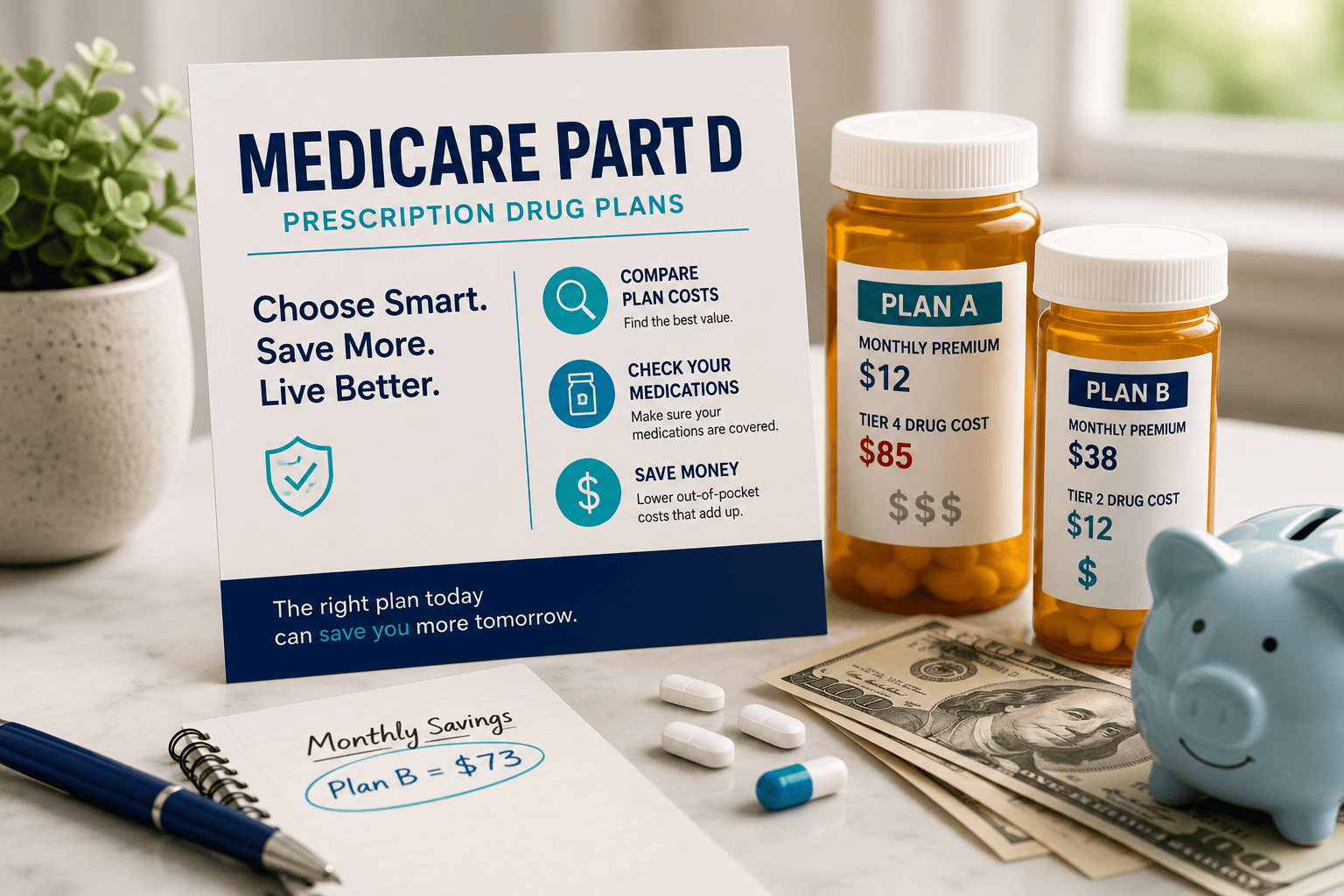
Here is a scenario that plays out thousands of times every Medicare open enrollment period. A retiree looks at a list of Part D drug plans, sorts them by monthly premium, picks the cheapest one, and calls it done. Then they fill their first prescription of the year and discover the medication they take every day for their blood pressure, the one they have been on for ten years, is on Tier 4 instead of Tier 2. Their copay is $85 per fill instead of $12. Over twelve months, that difference is close to $900 out of pocket, on top of the premium they thought they were saving.
This happens because Part D plans are not all the same. Every plan has its own formulary, its own tier structure, its own pharmacy network, and its own cost-sharing rules. The plan that is right for someone who takes a handful of common generics might be exactly wrong for someone who depends on a brand-name specialty medication. The only way to know which plan is right for you is to check your specific medications against each plan’s actual formulary before you enroll.
This is what we do for every Medicare client who walks through our door. And it changes outcomes.
What Medicare Part D Actually Is
Medicare Part D is the prescription drug benefit within Medicare. Congress added it in 2006, and it has become one of the most important components of a complete Medicare strategy. Part D coverage is delivered through private insurance companies approved by Medicare. You can get it in one of two ways: as a standalone Prescription Drug Plan that you pair with Original Medicare or a Medigap policy, or as part of a Medicare Advantage plan that bundles drug coverage with your medical benefits.
Without any form of Part D coverage, you pay full retail price for every prescription you fill. For many retirees, that is not a realistic option. Average retail prices for brand-name medications have climbed dramatically over the past decade, and specialty drugs for conditions like rheumatoid arthritis, cancer, or multiple sclerosis can run thousands of dollars per month without coverage.
Understanding Formularies: The List That Determines Your Cost
A formulary is the list of medications a plan covers, organized into tiers. Every Part D plan has one, and every plan’s formulary is different. What is on Tier 2 in one plan may be on Tier 4 in another. A medication that is covered at all in Plan A may not be covered at all in Plan B.
Formularies change every year. A drug that was a preferred generic last year may have moved to a higher tier this year because the plan renegotiated its pharmacy contracts. This is why the Medicare experts who tell you to review your Part D plan every single year are not just being cautious. They are giving you genuinely important advice.
Most Part D plans organize their formularies into four or five tiers:
Tier 1 covers preferred generic drugs at the lowest copay, often just a few dollars per fill. Tier 2 covers non-preferred generics at a slightly higher but still modest cost. Tier 3 covers preferred brand-name drugs at a meaningfully higher copay. Tier 4 covers non-preferred brand-name drugs at a cost that can run $50 to $100 or more per fill. Tier 5 covers specialty medications, the most expensive category, which may require a percentage-based coinsurance rather than a fixed copay.
When you understand this structure, you understand why the plan comparison process is so important. Moving one medication from Tier 4 to Tier 3 by choosing a different plan can save you hundreds of dollars per year.
Pharmacy Networks and Why They Matter
Most Part D plans have a network of preferred pharmacies where you will pay the lowest cost-sharing amounts. Using a non-preferred pharmacy, even one your plan technically covers, can meaningfully increase what you pay per prescription. Mail-order pharmacies deserve special attention: many plans offer 90-day supplies through mail order at a significantly lower cost per day than filling 30-day supplies at a retail pharmacy. For maintenance medications you take every month without change, mail order can produce real, compounding savings.
The Late Enrollment Penalty: A Consequence That Lasts
This is one of the most important things to understand about Part D, and one of the most commonly ignored. If you go without creditable drug coverage for 63 days or more after you first become eligible for Part D, Medicare can permanently increase your Part D premium as a penalty. The penalty is 1 percent of the national base beneficiary premium multiplied by the number of months you went without coverage, and it stays with you for as long as you have Part D coverage.
The penalty sounds small in percentage terms but adds up over years. And since the penalty lasts indefinitely, a retiree who delays Part D enrollment for two years can end up paying a surcharge for the next twenty years of their life. The solution is simple: enroll in Part D when you first become eligible, even if you take no medications today.
Changes Coming in 2025 and Beyond
The Inflation Reduction Act made significant changes to Part D, some of which took effect in 2024 and others that continue rolling out through 2025 and 2026. The $2,000 annual out-of-pocket cap for Part D beginning in 2025 is one of the most meaningful changes to Medicare drug coverage in years, particularly for beneficiaries who take high-cost specialty medications. Understanding these changes and how they interact with the plan you choose matters more than ever.
How to Choose the Right Part D Plan
The process is more straightforward than it sounds when you have the right help. You gather a list of every medication you take, including the dose and how frequently you fill it. You bring that list to a Medicare specialist who checks each plan’s formulary and calculates your total annual cost, including premiums, copays, and any deductibles. You then compare total annual cost across plans, not just monthly premium. And you pick the plan with the lowest total cost that includes your medications at a cost you can manage.
Generic vs Brand Name: A Real Difference in Real Dollars
Generic medications contain the same active ingredients as their brand-name counterparts and must meet the same FDA standards for safety and effectiveness. The price difference is substantial. Generics typically cost 80 to 85 percent less than equivalent brand-name drugs. When your doctor is willing to prescribe a generic alternative, and many maintenance medications have them, the savings over a retirement that spans 20 or 30 years are significant. This is a conversation worth having with your doctor, and one we can help you frame.
Real-World Example: Dorothy
Dorothy is 68 and takes five medications: two generics for blood pressure, a brand-name statin her doctor prefers, a brand-name inhaler for mild asthma, and a specialty medication for rheumatoid arthritis. When she first enrolled in Medicare, she chose the Part D plan with the lowest monthly premium: $14 per month. She did not check whether her specialty medication was on the formulary. It was not. She paid full retail price for it for an entire year: nearly $3,200 out of pocket. The following year, during open enrollment, she worked with OG Insurance HQ to find a plan with a slightly higher premium that covered her specialty medication on Tier 5 with a $120 monthly copay. Her annual out-of-pocket cost dropped by over $1,700. That is not a hypothetical. That is what proper plan comparison looks like.