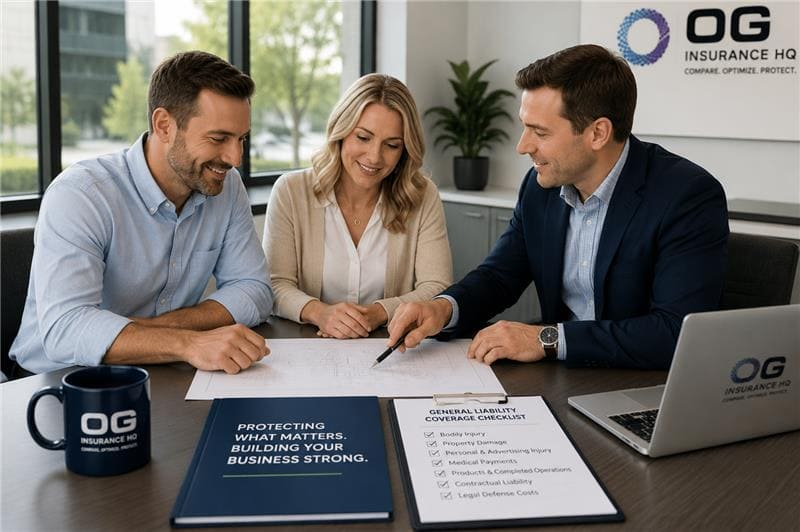
General liability is often called the foundation of commercial insurance, and for good reason. It is usually the first policy a new business buys, the one almost every client contract or commercial lease requires, and the coverage that protects you against the most common claims a business will ever face: third party injuries, property damage, and the legal costs that come with defending against them.
What Is General Liability Insurance?
General liability insurance protects your business from financial loss if you are found responsible for bodily injury, property damage, or certain other claims brought by a third party, such as a customer, vendor, or member of the public. It is not designed to cover your own employees (that is workers compensation) or your own property (that is commercial property coverage). Instead, it covers the world outside your business when your operations cause harm to someone else.
A standard general liability policy typically covers:
- Bodily injury claims, such as a customer slipping and falling on your premises
- Property damage claims, such as accidentally damaging a client’s property while performing work
- Personal and advertising injury, including claims of libel, slander, or copyright infringement in your marketing
- Medical payments for minor injuries, regardless of fault, to avoid a larger lawsuit
- Legal defense costs, even if a claim against you is ultimately found to be groundless
Why General Liability Insurance Matters
Lawsuits are expensive even when you win. According to research from The Hartford, the average slip and fall claim alone costs between $20,000 and $45,000 once medical bills, lost wages claims, and legal fees are added together, and nearly 30 percent of small business injury claims involve exactly this type of incident. Without general liability coverage, those costs come directly out of your business, and often out of your personal assets if your business is not properly shielded.
Beyond the financial risk, many landlords will not sign a commercial lease without proof of general liability coverage, and many client contracts, especially in construction, consulting, and event services, will not move forward without it. In practical terms, general liability is not optional. It is the entry ticket to operating credibly in your market.
Real World Example
A small landscaping company was trimming trees near a client’s driveway when a falling branch struck and damaged a parked car belonging to a neighbor. The neighbor filed a claim for vehicle repairs and a rental car during the repair period. The landscaping company’s general liability policy covered the full cost of the claim, just under $9,000, with no out of pocket expense to the business owner. In a separate incident the same year, a customer visiting the company’s small retail nursery slipped on a wet walkway and required emergency room treatment. That claim, including medical payments and a settlement to avoid litigation, totaled close to $31,000. Both claims were resolved without threatening the business’s survival, precisely because general liability coverage was already in place.
Who Needs General Liability Insurance?
General liability is appropriate for virtually every business type, including:
- Contractors and tradespeople working on client property
- Retail stores and restaurants with regular foot traffic
- Professional service firms meeting clients in an office
- Event planners, photographers, and mobile service providers
- E-commerce businesses with any physical presence, such as a warehouse or pop-up shop
- Freelancers and consultants who sign client contracts requiring proof of coverage
Common General Liability Claims
The claims OG Insurance HQ sees most often on general liability policies include:
- Slip and fall or trip and fall injuries on business premises
- Accidental property damage caused during a service call or installation
- Injuries caused by products sold or distributed by the business
- Advertising or copyright disputes tied to marketing materials
- Damage to a third party’s property while work is being performed
- Allegations of slander or libel connected to online reviews or public statements
What Affects General Liability Insurance Costs?
General liability premiums are driven by your industry’s inherent risk level, your annual revenue and payroll, the number of locations you operate, your claims history, and the coverage limits you select. A roofing contractor will pay a different rate than a bookkeeping firm, even with similar revenue, because the physical risk of the work itself is dramatically different.
According to Insureon, the average cost of a general liability policy for a small business is about $45 per month, typically based on $1 million per occurrence and $2 million aggregate limits, which are the limits most commercial leases and client contracts require. Higher risk industries, larger payrolls, and a history of prior claims will all push that average upward.
Choosing The Right Coverage Limits
The standard $1 million per occurrence and $2 million aggregate limit works for most small businesses, but it is not automatically the right number for every operation. A construction company working on large commercial projects, a business with high foot traffic, or a company operating in a litigious region may need higher limits, sometimes paired with a commercial umbrella policy for additional protection above the base general liability limit. The right move is to look at the contracts you sign, the size of the properties or job sites you work in, and the realistic worst case scenario for your specific operations, then size your limits to match.
Frequently Asked Questions
Why Businesses Choose OG Insurance HQ
General liability is the policy every business needs, but the right limits, exclusions, and endorsements vary by industry and operation. OG Insurance HQ uses advanced analytics to compare general liability options across top carriers, optimize the limits to match your real exposure, and protect your business from the everyday risks that come with simply being open. Compare. Optimize. Protect.